ADVERTORIAL | ESSENTIAL WOMEN'S HEALTH
Her Doctor Suggested Iron. After Five Formulas, She Couldn't Stand the Thought of Starting Again.
By Dr. Petra Novotná | Updated August 2026

Claire Waited Until the Car Door Shut
Claire kept both hands in her lap until the shaking stopped. Her clinician had finally named the problem: low ferritin. That should have felt like relief. Part of it did. Then came the plan. Start iron again. She made it through the appointment, thanked everyone, and walked back to her car. Once the door closed, she put her forehead against the steering wheel and cried. I call her Claire. She's a fictional composite built from patterns in CAVAÉ's customer research. The symptoms came up again and again: brain fog by afternoon, hair on the bathroom floor, and not enough energy for the day. She was not crying because somebody had found something wrong. She was crying because the answer sounded exactly like the thing she had already failed to live with. The next bottle meant another schedule and another morning spent deciding whether taking care of herself was worth what the pill might do to her stomach. The appointment named the problem. It hadn't solved the routine.

She Had Already Tried to Be the Perfect Patient
Claire did what careful people do. She followed the plan. She bought the basic iron. When that became hard to tolerate, she bought the version people called gentler. She added vitamin C. She moved coffee. She changed the time of day. She put the bottle where she could not miss it. For a while, every new plan felt hopeful. Then came the stomach ache. The constipation. The dread that arrived before the cap even came off. Some mornings she took the pill and spent the rest of the day regretting it. Other mornings she skipped it, then carried the guilt instead. The half-used bottles collected behind the bathroom door. Each one seemed to say the same ugly thing: you did not try hard enough. But that was not true. Claire had discipline. What she did not have was an iron routine that could survive an ordinary Tuesday.
Five Formulas Turned Self-Blame Into a Pattern
Claire's story is dramatized. This next sentence is not. One woman in CAVAÉ's post-purchase survey wrote: Five formulations. Not one careless try. Across the same survey, 45 of the 67 respondents who answered the failed-solution question said iron pills had already let them down. Across all 82 responses, fatigue appeared in 56, hair shedding in 39, brain fog in 32, and pill-related sickness or constipation in 20. A drawer full of unfinished iron does not automatically mean she lacked willpower. It can mean the routine was hard to live with."My doctor suggested I take iron supplements because of low ferritin and iron levels. I cannot stand the thought of restarting any of the oral supplements. I have tried five different formulations and they all give me a stomach ache or make me unbearably constipated."
A Real Hematologist's Work Explained the Missing Piece
Professor Clara Camaschella is a real internist and hematologist who studies iron disorders. In a review for the journal Blood, she describes how oral iron schedules and common side effects can affect whether people keep taking it. She also reviews evidence that bigger and more frequent oral doses are not automatically better. Lower single doses and alternate-day schedules can improve the fraction of iron absorbed and may be easier to tolerate. That paper did not test the oral strip described later on this page. Professor Camaschella does not endorse it. The practical point is simpler. Milligrams on the label are only part of the plan. The person still has to tolerate the routine and keep taking it. Claire had spent months comparing labels. She had never counted the days the bottle won.

The Label Can Show the Dose. It Cannot Show Tuesday.
A bottle can tell you what one serving contains. It cannot show how your stomach felt the last time you took it. It cannot show the skipped morning, the bottle hidden behind the toothpaste, or the little bargain that says, I will start again next week. This is the gap between a perfect protocol and a lived one. A high dose inside a closed bottle is still inside the bottle. A plan that creates dread asks for a fresh act of courage every day. Ask two questions: "How much iron is in this?" and "Can this routine make it through tomorrow?" Once Claire stopped treating that second question as weakness, she could finally judge iron by the part of the experience labels leave out.
But a Smaller Daily Dose Sounded Like a Compromise
There was still one hard objection. If an easier routine used fewer milligrams, was it just convenience dressed up as care? A randomized study followed 555 frequent blood donors after a donation. Participants assigned iron took either 19 mg or 38 mg of ferrous gluconate daily for 60 days. In the study's longitudinal analysis, the total-body-iron effects of those two doses were not distinguishable. The limits belong beside the finding. These were frequent blood donors, not a treatment-equivalence population. The study used ferrous gluconate. The strip described below uses ferric saccharate. It did not test that strip, prove equal clinical-treatment outcomes, or compare 19 mg with a 65 mg tablet. So this is not product proof. It is a reason to stop treating the largest milligram count as the only intelligent choice. The dose has to make sense. The routine has to survive real life. Ignoring either half creates another bottle Claire may never finish.

The Standard Had to Work on an Ordinary Morning
On an ordinary morning, the routine could not become a project. It had to travel easily, without a bottle rattling through the bag. Most of all, it had to remove the part Claire dreaded: swallowing another iron pill. Then she could track the days she used it, stay in touch with her clinician, and let a future retest settle the argument. That standard does not promise a miracle. It asks the product to make the daily step small enough to repeat. By then, Claire was no longer looking for the bottle that made the loudest promise. She was looking for the format she would still be using after the first wave of motivation was gone.
Then the 30-Second Iron Strip Made Sense
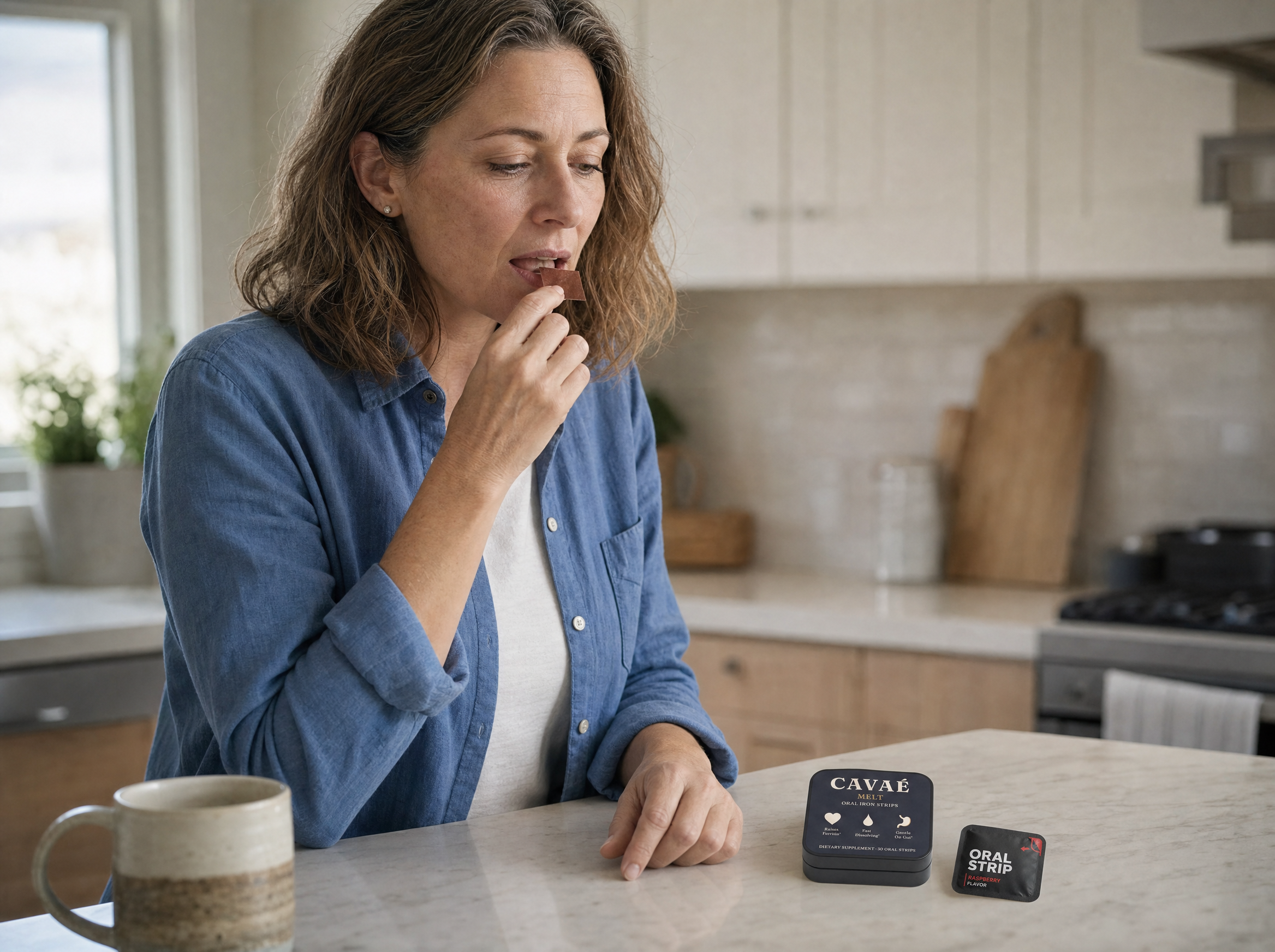
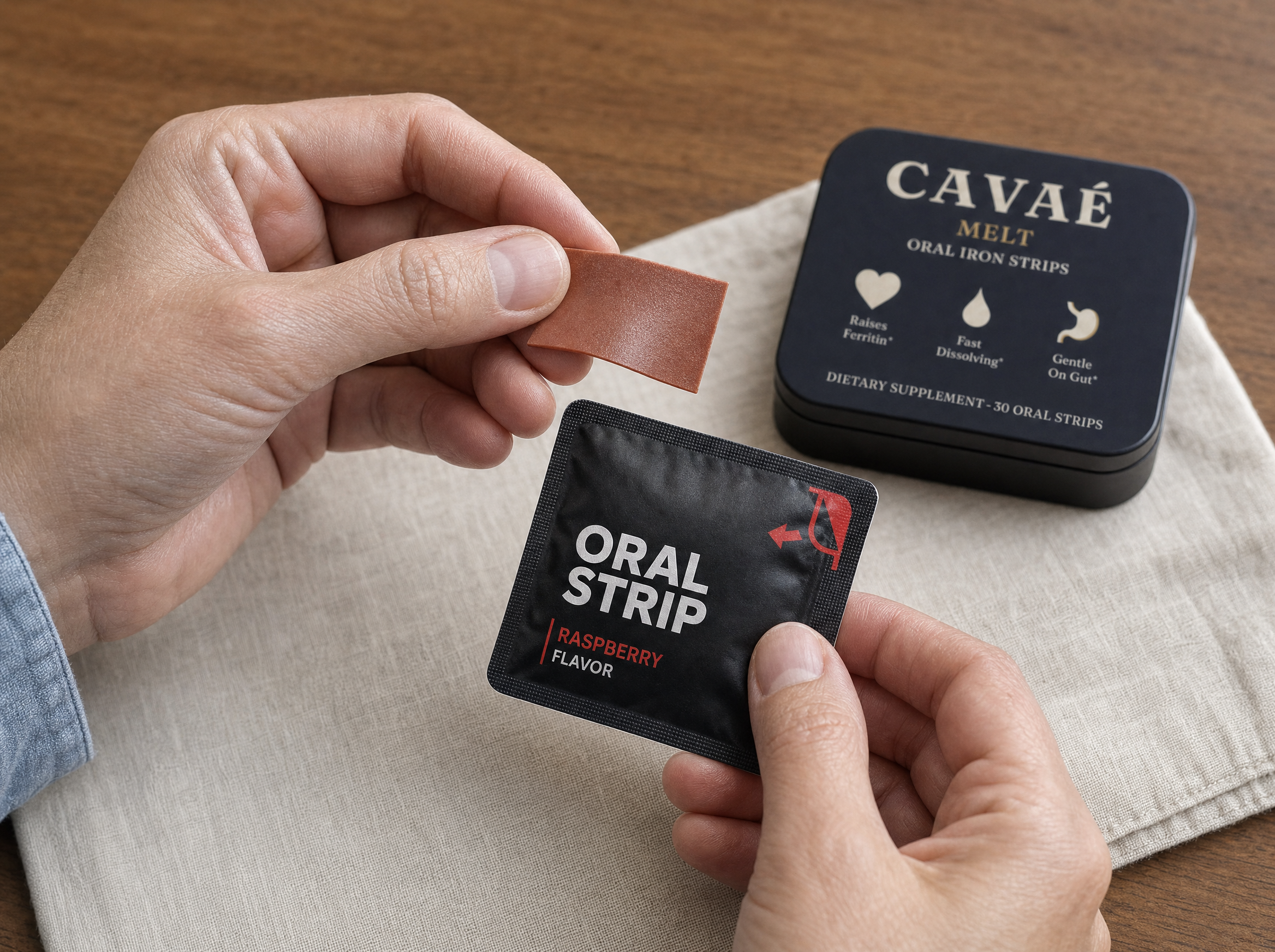
CAVAÉ Melt is a thin, raspberry-flavored oral strip with 19 mg of iron. Place one on your tongue once a day and let it dissolve in about 30 seconds. There is no capsule or tablet to swallow. No glass of water is needed. Each strip is sealed in its own sachet, so it can sit in a nightstand, work bag, or travel case. It removes the pill-swallowing step from a routine that had become a daily fight. It does not replace urgent care, prescribed treatment, or a clinician's advice. If an iron routine already works for you and you complete it comfortably, keep doing what works. CAVAÉ Melt was built for the woman who knows she needs iron and feels dread at the thought of opening one more pill bottle.
 SEE THE 30-SECOND IRON ROUTINE
Your Own Retest Gets the Final Vote
No fictional story, doctor byline, or polished image should decide whether an iron routine has earned your trust. Use the schedule your clinician recommends. Mark the days you actually take it. Notice whether the routine still creates hesitation. Retest when your clinician tells you to. CAVAÉ cites a 4.8 rating across 200+ reviews. That can help answer whether other buyers liked the experience. It cannot predict your result. Your own consistency and follow-up labs are the proof that matters.
What You Get and What It Costs
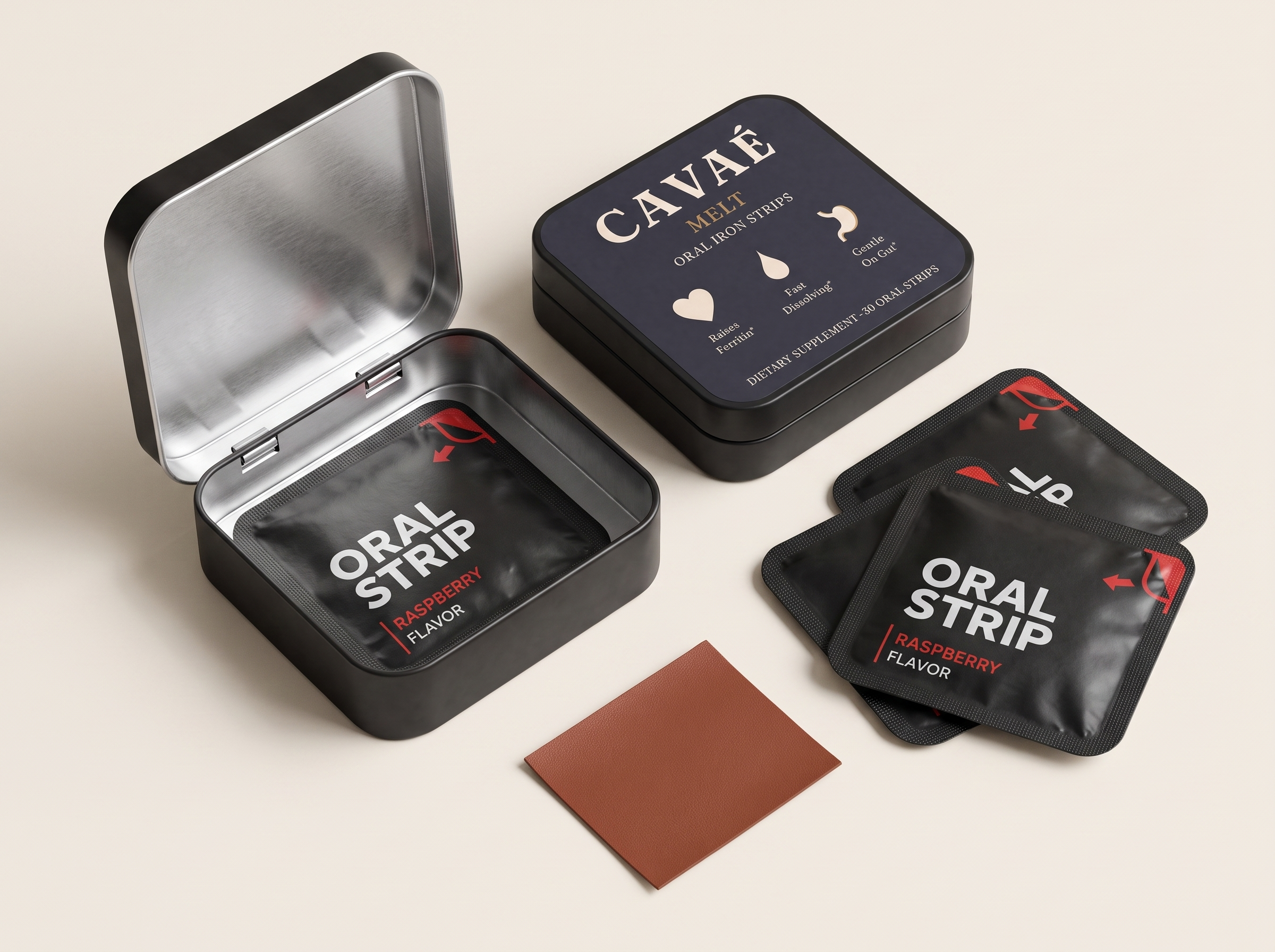
Each tin contains 30 individually wrapped raspberry strips. Each strip contains 19 mg of iron. Suggested use is one strip daily, unless your clinician tells you otherwise. One tin is currently $49.99 on the official product page. That costs more than basic drugstore iron. The value case is not that the strip is the cheapest iron on the shelf. It is that a routine you can complete has a different value than another inexpensive bottle left half-used. Multi-tin options are shown on the product page. Start with the amount that fits your budget and your retest plan. Orders are currently covered by a 60-day results-based money-back guarantee. It is not a general change-of-mind return policy. Lab timing, consistent-use, claim-deadline, and unused-product-return conditions apply. Read the current policy before ordering.
Five Questions to Answer Before You Order
Who is this made for? Women who know their ferritin history, have been told to supplement, and keep abandoning pills because the routine is unpleasant or hard to maintain. It is not a substitute for urgent care or prescribed treatment.
What is actually different? The format. CAVAÉ Melt is a thin, individually wrapped oral strip. It takes the pill-swallowing step and the need for a glass of water out of the routine. This page does not claim a special route into the body.
Can I take it with medications or other supplements? That depends on your health history and full routine. Show the label to your clinician or pharmacist before adding it.
When should I retest? Use the schedule your clinician recommends. There is no honest fixed timeline that fits everyone. How does the guarantee work? The current policy requires a baseline test taken on or before purchase or within 7 days of the first order, a follow-up test within 60 days showing relevant iron markers did not increase, consistent use, a claim submitted through support within 60 days, and return of unused product at your expense. It does not cover change of mind. Read the full policy.
You Do Not Have to Believe Claire's Ending. This story deliberately does not give her one. You only have to decide whether removing the pill could make your next iron routine easier to complete. Keep your clinician involved. Track the days. Let your retest answer the rest.
Start with the amount that fits your budget and the retest plan you made with your clinician. The point is to complete an honest trial, not to buy the biggest option.
PS: CAVAÉ Melt is sold on the official site. Purchases from unauthorized resellers are not covered by the 60-day money-back guarantee.
TRY A ROUTINE THAT DOES NOT START WITH A PILL
30 individually wrapped raspberry iron strips per tin. One strip a day. Choose the amount that fits your budget and retest plan.
See Current CAVAÉ Melt Options60-day results-based guarantee. Lab, use, return, and timing terms apply.
SOURCES
CAVAÉ post-purchase survey, 82 responses in the brand database as of August 3, 2026. The quoted response is reproduced verbatim.
Camaschella C. Iron deficiency. Blood. 2019;133(1):30-39. doi:10.1182/blood-2018-05-815944.
Bialkowski W, Kiss JE, Wright DJ, et al. Estimates of total body iron indicate 19 mg and 38 mg oral iron are equivalent for the mitigation of iron deficiency in individuals experiencing repeated phlebotomy. American Journal of Hematology. 2017;92(9):851-857. doi:10.1002/ajh.24784. PMCID: PMC5546996.
Neither paper tested CAVAÉ Melt. Professor Camaschella is not affiliated with and does not endorse CAVAÉ.

© 2026 CAVAÉ. All Rights Reserved. | Privacy Policy | Terms of Use
THIS IS AN ADVERTISEMENT. IT IS NOT MEDICAL ADVICE.
Dr. Petra Novotná is a fictional hematologist and dramatized editorial character. She is not a licensed clinician, a paid endorser, or a person who treated anyone described on this page. Claire is a fictional composite built from recurring themes in CAVAÉ's customer research; no single person's medical history or result is represented. Human images are AI-generated photo illustrations. The survey quotation is real and reproduced verbatim. Individual experiences vary. Ask your clinician whether iron supplementation and this format fit your needs.